Short Bio
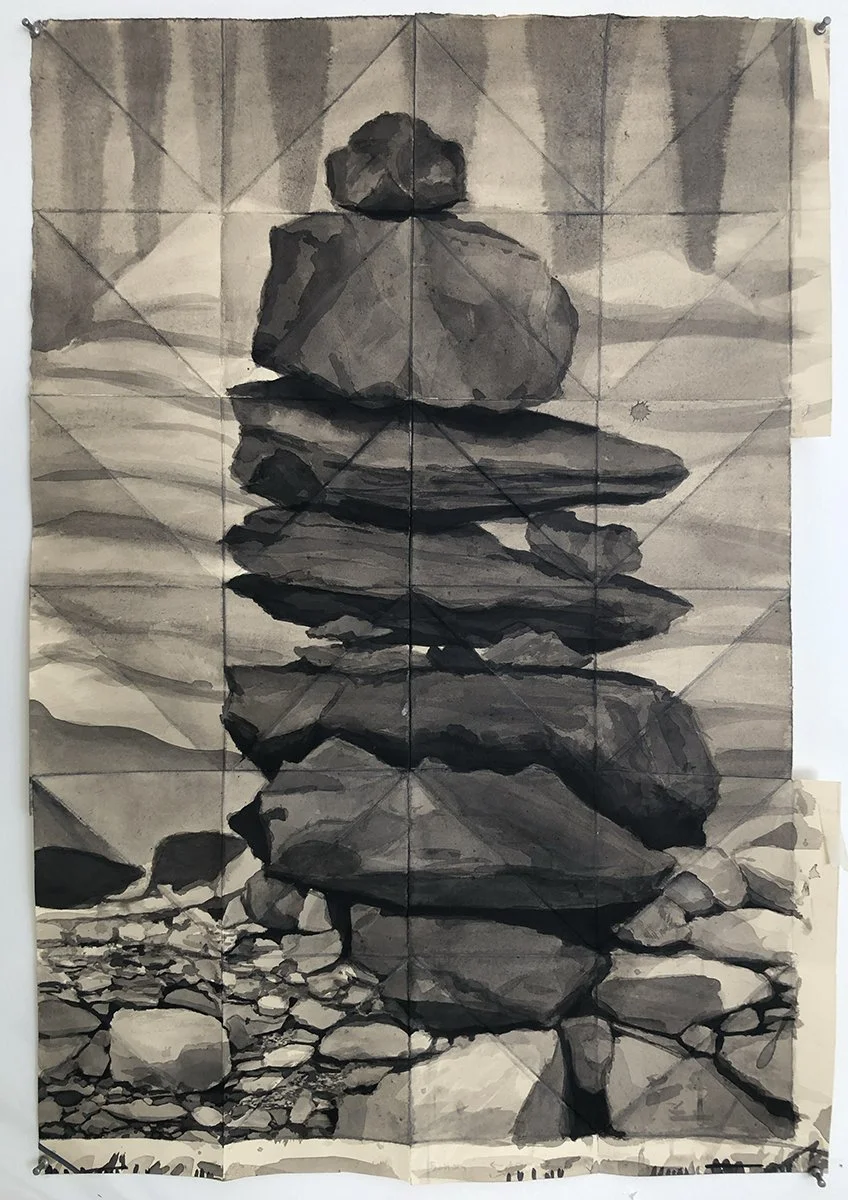
Matthew Mullins is an American painter and printmaker living and working in northern New Mexico. His work explores the natural environment through oil painting, traditional printmaking, and photography, drawing particular attention to the geologic forces that shape the landscape. His large-scale paintings combine New Mexico landscapes with intricate patterns derived from quilting and tiling, creating a playful tension between recognizable imagery and abstraction.
Mullins has exhibited his work in galleries and museums across the country, and his work is held in public and private collections internationally. His artwork has appeared in New American Paintings, The Wall Street Journal, and numerous other publications. He is the recipient of UC Berkeley’s Eisner Prize, the highest award given in the Humanities at UC Berkeley, and was a Fellow with UC Berkeley’s Arts Research Center. Mullins currently serves as Art Department Chair at Santa Fe Preparatory School.
Long Bio
Matthew Mullins (b. 1983) is an American painter and printmaker living and working in northern New Mexico. Born in Cincinnati, Ohio, Mullins moved frequently around the East Coast with his family before settling in the semi-rural outskirts of the San Francisco Bay Area. Much of his childhood was spent at the base of California’s Mt. Diablo, where he could walk up a creek bed into large areas of open wilderness. Those childhood and teenage wanderings continue to inform his work and his enduring fascination with the natural environment.
Mullins developed an early connection to the landscapes of the American Southwest through family road trips, stories of his father’s bicycle trips through the region in the 1970s and 80s, and his own solo backpacking trips throughout the Mojave Desert and Sierra Nevada. Landscape became increasingly central to his work, in 2012, after he moved to an off-grid earthship in Abiquiu, New Mexico. He now lives and works in Santa Fe with his wife and family.
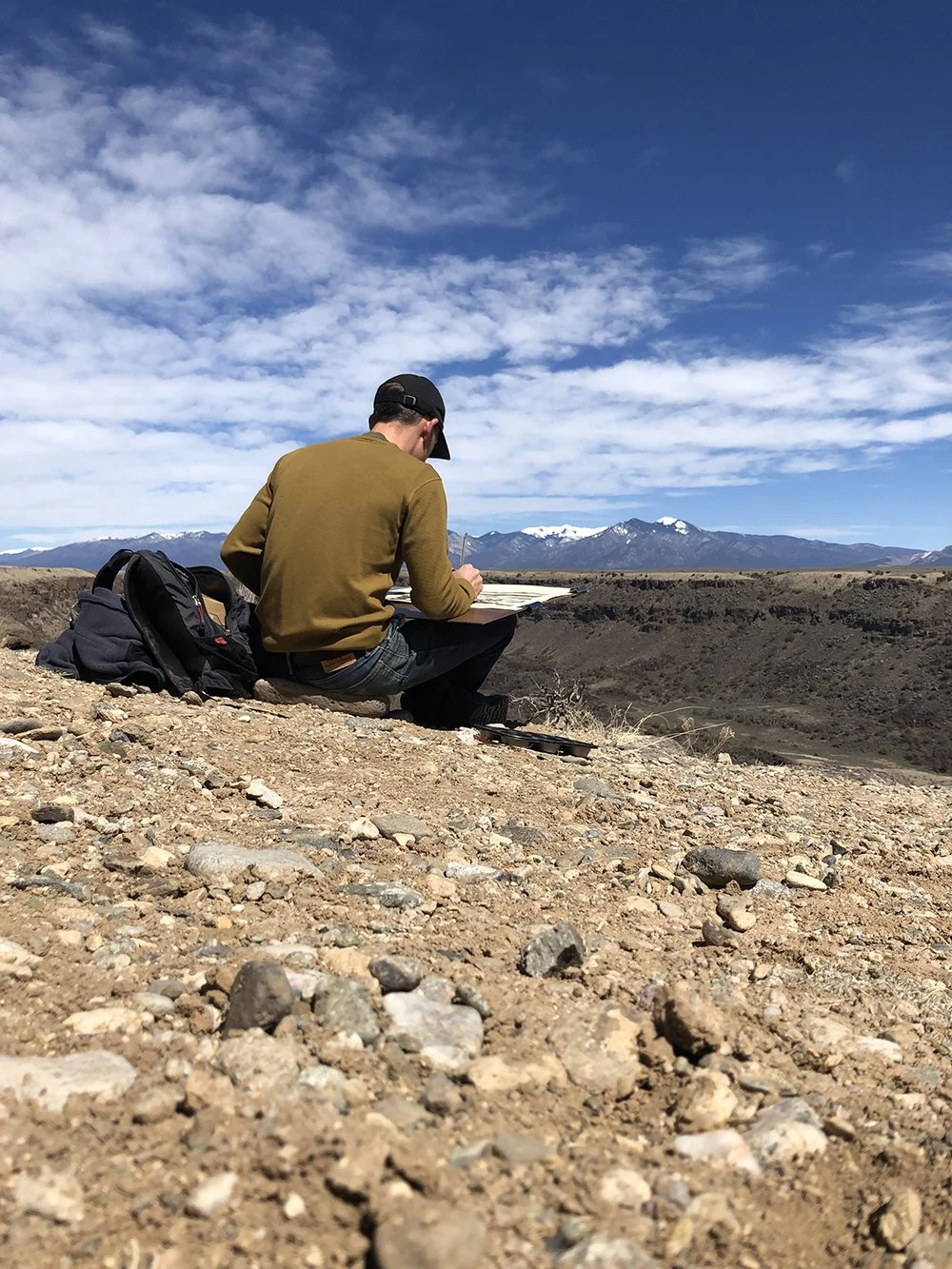
Mullins’ current work grows from a practice of close observation. His plein air sumi ink paintings serve as a way of slowing down and paying attention to the landscape, particularly the geologic forces and deep history visible in the terrain of northern New Mexico. These observations inform photographs and photographic collages that become loose foundations for his oil paintings, etchings, and large works on paper.
In his paintings, Mullins combines recognizable landscapes with grid-based patterns derived from quilting and tiling. Introduced late in the painting process, these patterns disrupt the landscape and create a tension between image and abstraction, recognition and uncertainty. The patterns invite the viewer to look longer and to become more aware of the process of seeing itself.
Mullins earned his MFA from the University of California, Berkeley, where he received the Eisner Prize, the university’s highest award in the Humanities, and was named a Fellow with the Arts Research Center. He has worked as a professional artist since 2005. His work has appeared in New American Paintings, The Wall Street Journal, and numerous other publications, and is held in public and private collections internationally. He has exhibited in galleries and museums across the United States.
Mullins is also an educator and currently serves as Art Department Chair at Santa Fe Preparatory School.
Artist Statement
My art begins with a simple, observation-based process that becomes layered, complicated, and transformed through the introduction of patterns. I make large paintings that weave together epic, but familiar to me, northern New Mexico landscapes with patterns derived from quilts and tiling. The resulting spaces are deep and dazzling, with elusive pattern elements that pull the eye back toward the painting’s surface.
These paintings have their foundation in plein air sumi ink painting, a practice I use to closely observe the landscape near my home. Painting outside, within the environment itself, helps me notice the forces shaping the land and deepens my wonder for these incredible places. Northern New Mexico starkly lays bare billions of years of geologic history alongside thousands of years of human history. The marks and scars left by these forces remain plainly visible in the landscape.
My plein air paintings also help me compose photographs while I am in these places. I often digitally collage and manipulate these photographs to recreate the feeling and immediacy of the original ink paintings. The resulting photographs and photographic collages become loose foundations for my oil paintings, etchings, and large works on paper.
When the landscape is about three-quarters complete, I complicate the process by introducing flat screens of pattern. These grid-based, repeating structures playfully disrupt the image and then, ideally, find a way to harmonize with it. They create new rhythms, strengthen compositional flow, and draw my attention to details I might otherwise miss. There is a constant push and pull between the pattern and the image. I am trying to make them work together, but I also enjoy the moments when they fight with each other. There is something of a game in that struggle.
We are remarkably good at quickly recognizing things and giving them names: mountain, tree, sky, road, house. Once we decide what something is, we can stop looking and move on. I use pattern to interrupt that automatic process. It makes the image a little harder to read and encourages the eye to keep discovering. Ideally, the viewer becomes aware of the act of looking itself: seeing the way the mind takes incomplete information, searches for connections, and happily turns it into a whole picture.